Our scientific process
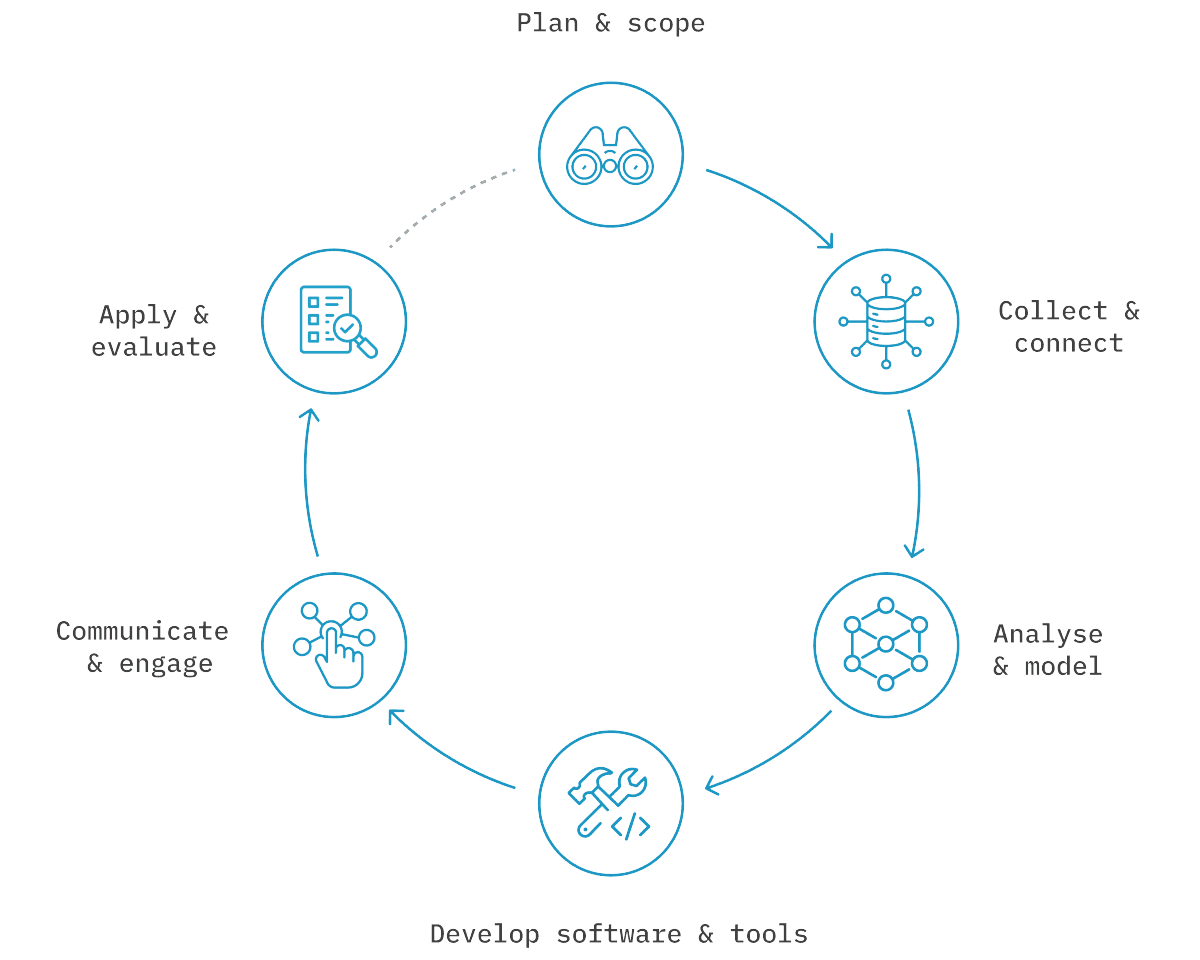
Our six-step scientific process helps us produce science that’s robust, transparent and repeatable, and importantly, applied in the real world where it can have an impact.
It takes us from understanding the questions we’re trying to answer, through research and analysis, to developing tools, sharing findings, supporting decisions and evaluating the impact.
-

1. Plan & scope
We love a good question, especially one that doesn’t have an obvious answer. We work with our clients to understand what they’re trying to achieve, design the research and work out the best way to approach it. Sometimes that means developing entirely new methods, approaches or software.
-
2. Collect & connect
We can bring together almost any source of data, from clean, structured datasets (rare as they are!) to satellite imagery, LiDAR, audio, text, video, sensor data and historical records.
We can also collect the data ourselves through field surveys and monitoring. Our team is always happy to find an excuse to get the drones out.
-
3. Analyse & model
This is where our statisticians, scientists and data specialists get to do what they love. We use everything from Bayesian statistics and statistical models to machine learning and AI to find patterns, estimate populations, assess risks and explore possible futures.
When the right model or algorithm doesn’t exist yet, we’re quite happy to build one.
-
4. Develop software & tools
We like building things that people can use.
Our software developers and designers work alongside our scientists to create databases, interactive maps, dashboards and other tools that help people collect data, analyse it, and work with scientific results.
Some of these tools are built for a particular project. Others grow into products that we use across many projects and clients.
-
5. Communicate & engage
Good science deserves to be understood, shared and talked about.
We work with clients to communicate findings through reports, visualisations, interactive experiences and public engagement.
We also help bring communities, industry and other stakeholders into the conversation, so they can understand the evidence and contribute to decisions.
-
6. Apply & evaluate
For us, the best part is seeing science make a difference.
We work alongside our clients to apply the findings, whether that’s informing policy, improving management decisions, taking action on the ground, or evaluating impact.
Because the world doesn’t stand still, neither does our science. We’ve designed our process so that as circumstances change and new information becomes available, we can build on what we’ve already done and update our findings without starting from scratch.
How we can work together
We can work with you on any one of these six steps, support the whole process, or manage the process over time to keep the results up to date.
-
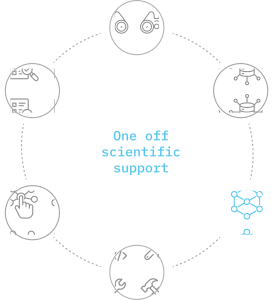
One-off scientific support
Have a particular question or problem? We can help with advice, analysis, reviews or specialist expertise when you need it.
-
End-to-end science
We can look after the whole process, from planning and collecting data through to applying the findings and evaluating the impact.
-
Ongoing scientific support
Some science needs to keep going. We can manage the research, data and software over time, keeping everything up to date.
Our products
Tools for better science
Alongside our scientific work, we’ve developed tools for collecting data, running scientific analysis and sharing research findings. Some of these tools began as part of our research and are now available for others to use.
-
 Find out more
Croissant
An AI-powered tool for analysing public submissions, helping organisations understand the views, themes and issues people are raising.
-
 Find out more
Deckhand
Software developed by Dragonfly to support fisheries data collection and reporting.
-
 Find out more (opens in a new tab)
Gateaux
A platform for scientific and analytical workflows that need to be shared, checked, repeated and kept up to date.

Our capabilities
Behind each step of our process is a team with deep technical expertise. Our capabilities include statistics and data science, data collection, remote sensing and Earth observation, specialist AI, data infrastructure, scientific software and reproducible science.