

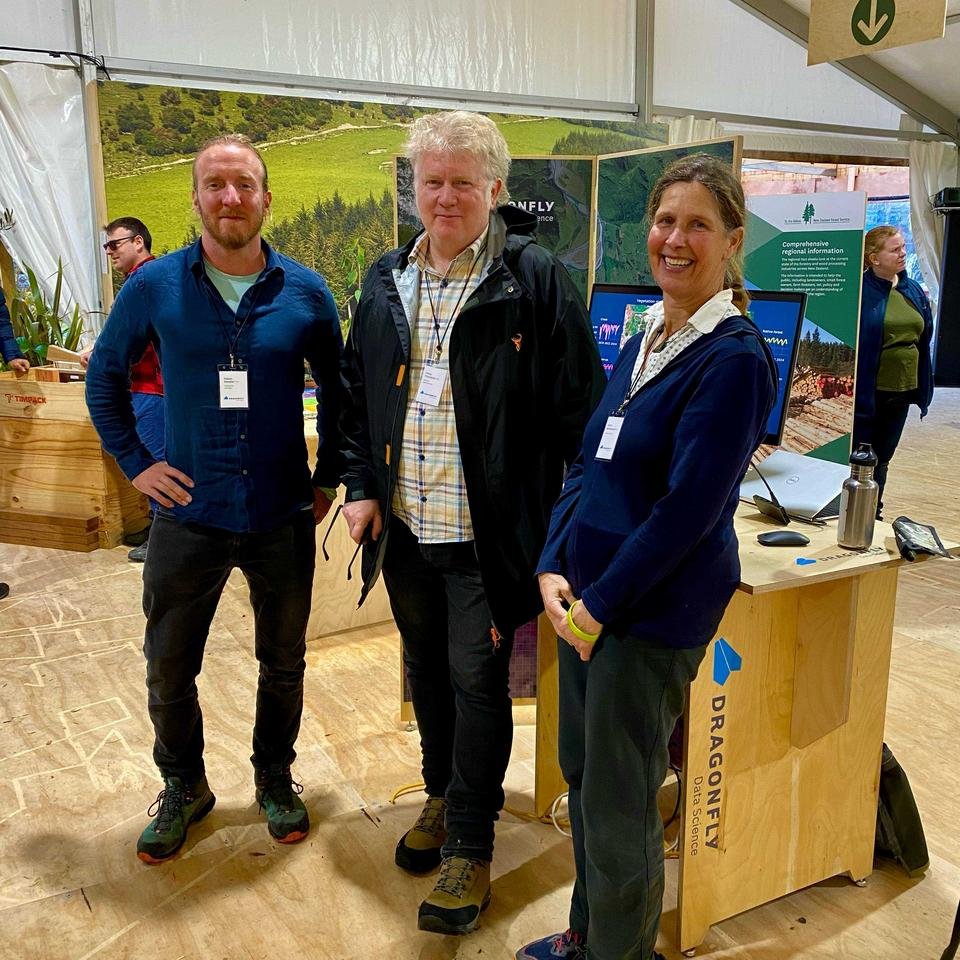
Dragonfly Data Science made its first appearance at Fieldays this year, as part of the MPI Forestry Hub. Director of Data Science, Dr Finlay Thompson, together with Dragonfly scientists, Dr Fabian Döweler and Dr Katrin Berkenbusch, used this event as a time to connect with farmers, landowners, and forestry professionals to talk about the challenges and opportunities in forestry management.
Seeing the trees
For many years, Dragonfly has used advanced AI and satellite imagery processing to bring rigour and scale to the measurement of canopy health and growth in forests. Most recently, this capability led to a partnership with NASA that aims to map every tree in New Zealand.
Fieldays, the Southern Hemisphere’s largest agricultural event, offered the perfect opportunity to meet people across the farming and forestry sectors, and share how satellite data can deliver real value. At the same time, it allowed the team to find out what kind of data or tools people were missing to help them manage their forests.
The untapped potential of forests
With nearly 40% of New Zealand’s land covered in native and exotic forests, the opportunity to unlock both environmental and financial value is significant. Yet, much of this potential remains untapped.
“There is significant value in forests on farmland, which is often not being realised because of a lack of clarity about how best to do this,” says Finlay.
Much of that opportunity lies in the growing voluntary carbon market, particularly overseas. Increasingly, the demand for high-quality carbon credit investment is outpacing what New Zealand’s Emissions Trading Scheme (NZETS) is currently able to provide.
“Large international companies with considerable carbon emission footprints are looking at offsetting by voluntarily investing in planting and maintaining forests, particularly native forests.”
“New Zealand has this incredible forest estate, with almost 40 percent of our land covered in forest. There is significant value both financially and for improving global biodiversity but it requires accurate information so that companies know their carbon investment is making change.”
“The international demand for planting of native trees supports carbon sequestration but also has benefits for biodiversity, freshwater management and land erosion.”
Tools to unlock opportunity
Ultimately, Dragonfly’s goal is to help landowners convert forest potential into tangible value, by making it measurable.
Recent advances in AI and satellite processing now allow the Dragonfly team to produce cost-effective, high-accuracy forest biomass models at scale. These models enable landowners to monitor forest growth over time, measure regeneration following pest control, and validate the outcomes of reforestation projects with confidence.
Unlocking this value requires more than just data—it also demands the right systems and support. Dragonfly is working closely with policymakers and regulators to build tools that help farmers and forest owners access to the emerging international carbon markets.
“New technologies and developments in AI are allowing us to measure tree biomass more accurately than has previously been possible. It’s a critical step toward helping New Zealand farmers generate value through high-quality carbon credits. There are significant opportunities here in Aotearoa.”
Read more
Get in touch
To talk to Dragonfly about this work, please get in touch with Dr Finlay Thompson (finlay@dragonfly.co.nz, +64 21 426 878)